- (408) 614-6589
- som@aria.edu
- 7329 Cesar Chavez Rd., French Camp, CA 95231


School of Medicine Initiative (MD Program)
Aria University, is an accredited university located in Milpitas, California. Aria University is embarking on a bold and innovative academic initiative to establish a medical school in San Joaquin Valley to educate and train a diverse workforce of physicians and developing innovative health care delivery programs that will improve the health of population in the medically underserved areas in the San Joaquin Valley. This proposal for funding and collaboration sets the target to raise $67 million over five years to support Aria University’s medical school initiative to address the community’s medical needs at a regional level.
The University School of Medicine will meet health care needs by serving as a locus for expanded medical care; by educating physicians who are likely to enter residencies, and later practice, in the state or region; and by training a culturally competent and diverse physician workforce. To help meet the projected need
for health care providers, the Aria University School of Medicine plans to create cutting-edge medical programs and collaborate with regional partners in providing healthcare to San Joaquin Valley areas. The university projects that by 2032, its medical programs will have enrolled 520 students in its medical
program. The Aria University Medical School will contribute approximately $200 million in direct, indirect, and induced contributions to the San Joaquin Valley local economy by 2032-33.
Aria University is a private nonprofit university registered in the State of California. It is accredited by the WASC Senior College and University Commission (WSCUC), an accrediting body approved and recognized by the United States Department of Education. Its main campus is located at 1521 California Circle, Milpitas, California 95035. Aria University offers a range of graduate, diploma, and certificate programs and fosters a learning environment supported by technology and innovation to a worldwide student body. The main objective of Aria University is to offer comprehensive educational programs in the fields of arts, culture, language, health, technology, leadership, education, and sciences based in the strong grounding of Indian values, cultural, technological, scientific, health, and psycho-spiritual traditions. Aria University believes that the whole world is one family.
Executive Summary

Aria University intends to establish a medical school, which is projected to open in the fall of 2027. The medical school aims to develop innovations in medical education and health care delivery while improving the overall quality and availability of healthcare services in the San Joaquin Valley. It will focus on addressing the needs of the medically underserved in the region, building on Aria University’s already established record of excellence. Despite its rapid growth, the San Joaquin Valley faces significant economic hardships and health problems. It has the lowest ratio of health care providers to population, with fewer health care professionals per 100,000 residents than other regions in California. Furthermore, approximately 30 percent of this already limited workforce is approaching retirement age. Aria University also seeks to address the health care workforce shortage by enrolling, educating, and training a new cohort of physicians for one of California’s most underserved areas.
The Model
The Aria University School of Medicine’s model blends robust teaching with a distributed clinical education system. This approach immerses students and residents in various healthcare settings and populations, highlighting the physician’s role in enhancing medical treatment and utilizing Aria University’s strengths.
The Aria University School of Medicine will utilize a distributed clinical system—one which is both consistent with the proposed mission and, at the same time, socially and economically advantageous. Aria University will partner with regional hospitals, clinics, and providers for its clinical programs. A distributed model will allow the Aria University School of Medicine to train students in a variety of
healthcare settings and populations throughout the San Joaquin Valley region. Because data show that physicians tend to practice where they do their residencies, over time this approach will result in
greater access to healthcare for a broader base of a diverse and currently underserved population. At the same time, the distributed model allows for leveraging existing healthcare resources by partnering
with regional hospitals and clinics.
Aria University is well aware of the responsibilities for assuring the highest standards of care in all clinical and/or hospital facilities with which it will operate or affiliate. It is also understood that there are particular challenges in assuring quality of care in a distributed clinical model.
National need
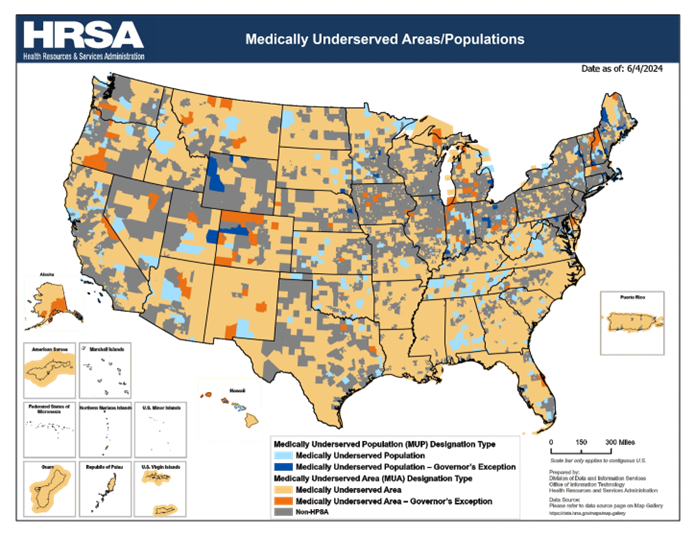
There is a nationwide shortage of qualified physicians in United States. Various studies suggest national shortfalls of more than 100,000 physicians over the coming decade. A June 2021 report of the Association of American Medical Colleges stated that “To bring rates of care for currently underserved populations up to the rates for populations facing fewer sociodemographic, economic, and geographic barriers to care, 102,400 to 180,400 more physicians would be needed (relative to the current supply). Even assuming current utilization patterns continue, over the next 15 years, demand for physicians is projected to increase by 136,000 FTEs under the Status Quo Scenario.” This projected need is based on population growth, the aging of the population, and the concomitant aging of the physician workforce